XIAO ESP32-S3 vs C3 vs C6: Which XIAO to Buy
XIAO ESP32-S3 vs ESP32-C3 vs C6 on memory, radios, antenna, battery charging and deep sleep, from Seeed's wiki, plus why OpenGizmo runs on the S3.
- Author
 Mauro Brambilla
- Published
- Reading time
- 8 min
- Category
- Comparisons
In short
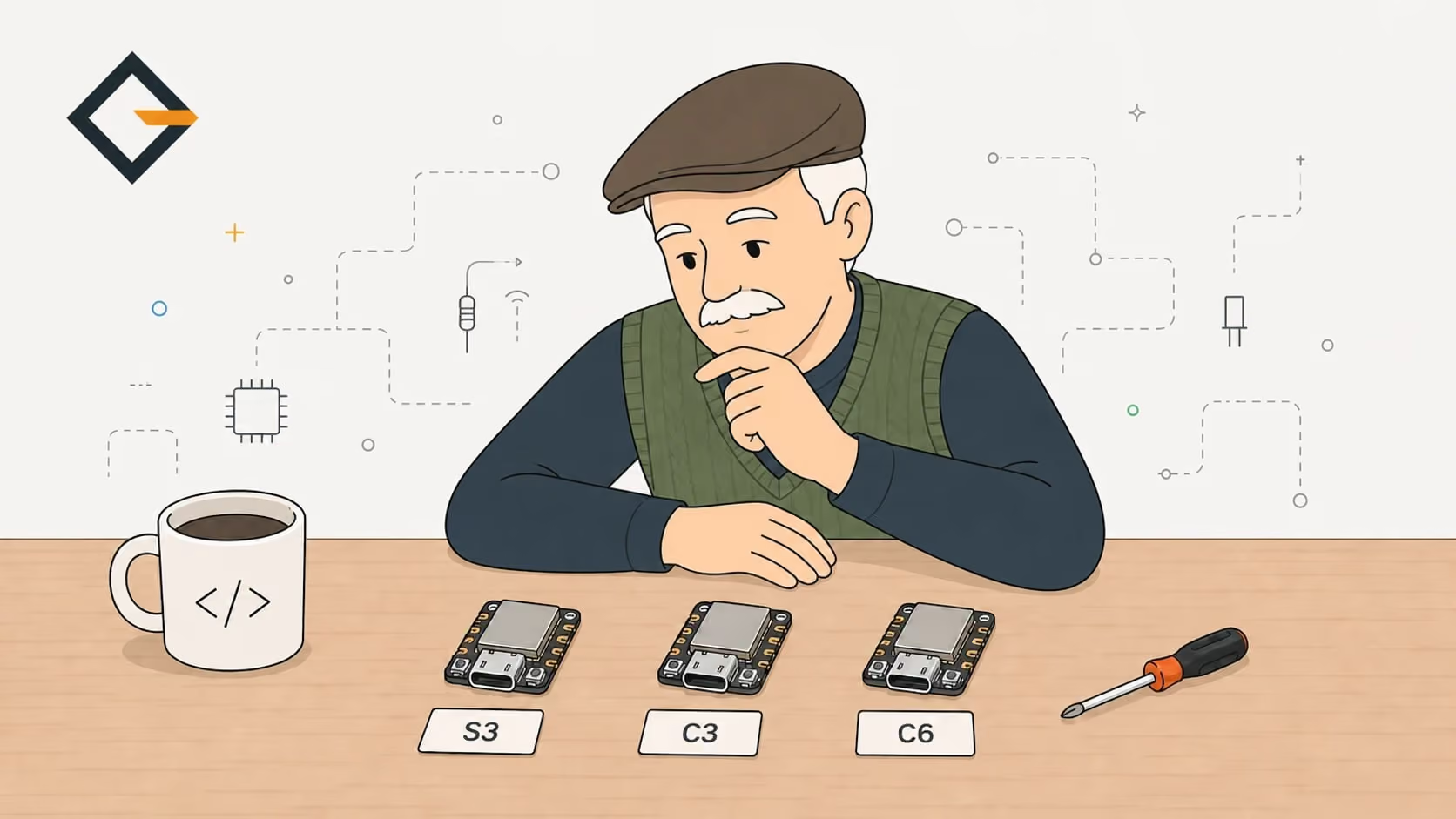
Buy the XIAO ESP32-S3 for displays, web servers and headroom (8 MB PSRAM, 8 MB flash). Pick the C6 for Thread, Zigbee or Wi-Fi 6, and the C3 only for a simple, cheap Wi-Fi node.
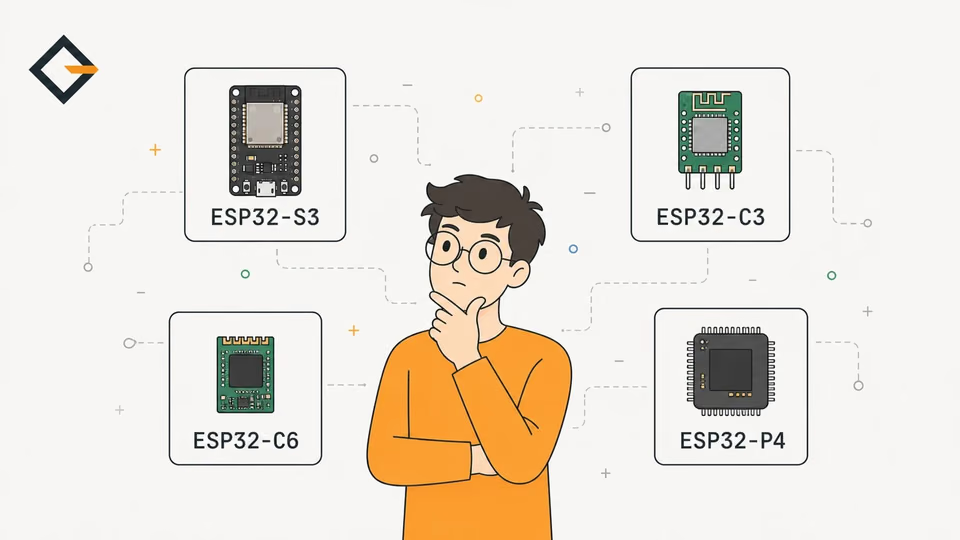
Buy the XIAO ESP32-S3 unless you have a specific reason not to: it has two cores, 8 MB of PSRAM and 8 MB of flash, against the XIAO ESP32-C3's single core and 4 MB of flash. The XIAO ESP32-C6 is the pick for Wi-Fi 6, Thread or Zigbee.
Seeed Studio sells all three in the same 21 x 17.8 mm footprint, so they look interchangeable at a glance. They are not, and this post compares them at board level: Seeed's wiki pages for the specs, a bench measurement for sleep current, and the two OpenGizmo projects that run on the S3. If you are still choosing between chip families, start with which ESP32 to buy; here we only choose between three boards.
Which XIAO should you buy: S3, C3 or C6?
Pick by the first need that applies:
- Thread, Zigbee, Matter over Thread or Wi-Fi 6: the XIAO ESP32-C6, the only one of the three with an 802.15.4 radio.
- A display, a web server, JSON over HTTPS, a camera or room to grow: the XIAO ESP32-S3 (the Sense variant adds the camera).
- A small Wi-Fi and Bluetooth LE node with no big buffers: the XIAO ESP32-C3.
The order matters because the first need is the only one nothing else can meet. Thread and Zigbee need a radio the S3 and C3 simply do not have. After that, the S3 against the C3 is a question of headroom, and the table below shows how large the gap is on paper.
How do the XIAO ESP32-S3, C3 and C6 compare on specs?
All three boards are 21 x 17.8 mm with 11 PWM-capable GPIO pads and USB-C, according to Seeed's wiki pages for the S3, the C3 and the C6. The differences are in the chip behind the pads:
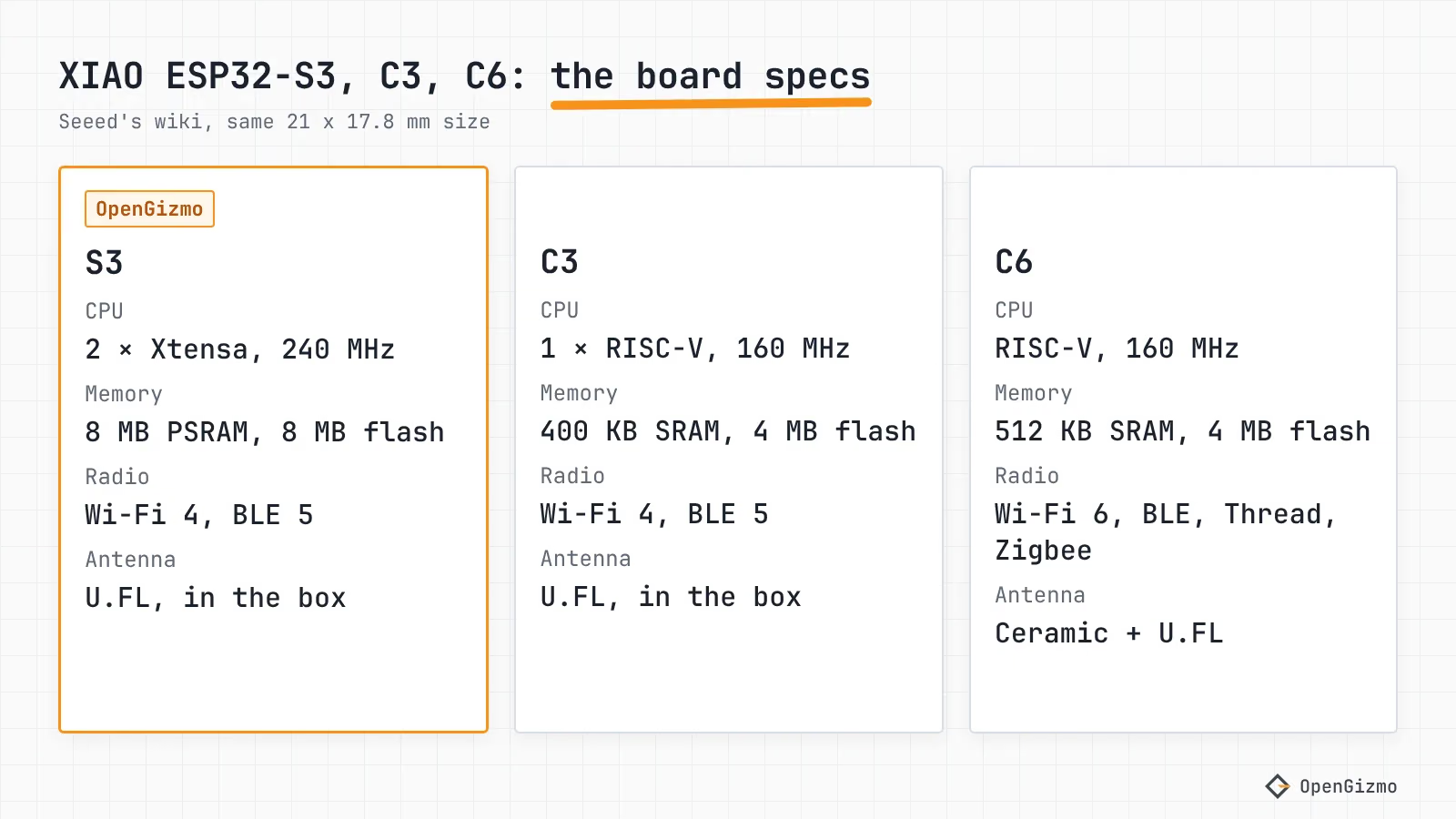
| Spec (Seeed wiki) | XIAO ESP32-S3 | XIAO ESP32-C3 | XIAO ESP32-C6 |
|---|---|---|---|
| CPU | 2 × Xtensa LX7, up to 240 MHz | 1 × RISC-V, up to 160 MHz | RISC-V, 160 MHz plus a 20 MHz low-power core |
| Memory | 8 MB PSRAM, 8 MB flash | 400 KB SRAM, 4 MB flash | 512 KB SRAM, 4 MB flash |
| Wireless | Wi-Fi 4, Bluetooth LE 5.0 | Wi-Fi 4, Bluetooth LE 5.0 | Wi-Fi 6, Bluetooth LE, Zigbee, Thread |
| Antenna | U.FL only, antenna in the box | U.FL only, antenna in the box | Ceramic on the board, plus U.FL |
| ADC inputs | 9 | 4 | 7 |
| Battery charging | 50 mA fast, 3.8 mA trickle (merged table cells) | 380 mA fast, 40 mA trickle | Not stated |
| Deep sleep | 14 µA | 44 µA | 15 µA |
Three details deserve a comment, because the wiki leaves them easy to miss. First, the S3 is the only one of the three with PSRAM, the extra RAM chip that holds frame buffers and large parsed documents. Second, the S3 and C3 have no antenna on the board: Seeed's wiki says to take the antenna from the package and clip it on the U.FL connector, and the C6 is the one with a ceramic antenna already on the PCB. Third, the C6 page lists Bluetooth 5.3 in its introduction and Bluetooth LE 5.0 in its spec table, so I would not buy the C6 for a specific Bluetooth version without checking the chip's datasheet.
The chip underneath matters too. The S3 datasheet lists 45 GPIOs, USB OTG and Bluetooth 5 LE, the C3 datasheet lists a single core at up to 160 MHz and USB Serial/JTAG only, and the C6 datasheet lists Wi-Fi 6 with Zigbee 3.0 and Thread. A XIAO breaks out only 11 of those pins, so the chip's GPIO count never reaches the pads. Seeed's wiki reports the Plus variant with 18.
Which XIAO ESP32 draws the least power in deep sleep?
Seeed's wiki lists 14 µA for the S3, 15 µA for the C6 and 44 µA for the C3 in deep sleep. Deep sleep is the chip's lowest mode, with the CPU stopped and only a small part of the chip kept alive to wake it. The ranking is not what the chip datasheets alone would suggest, because the board adds its own parts.
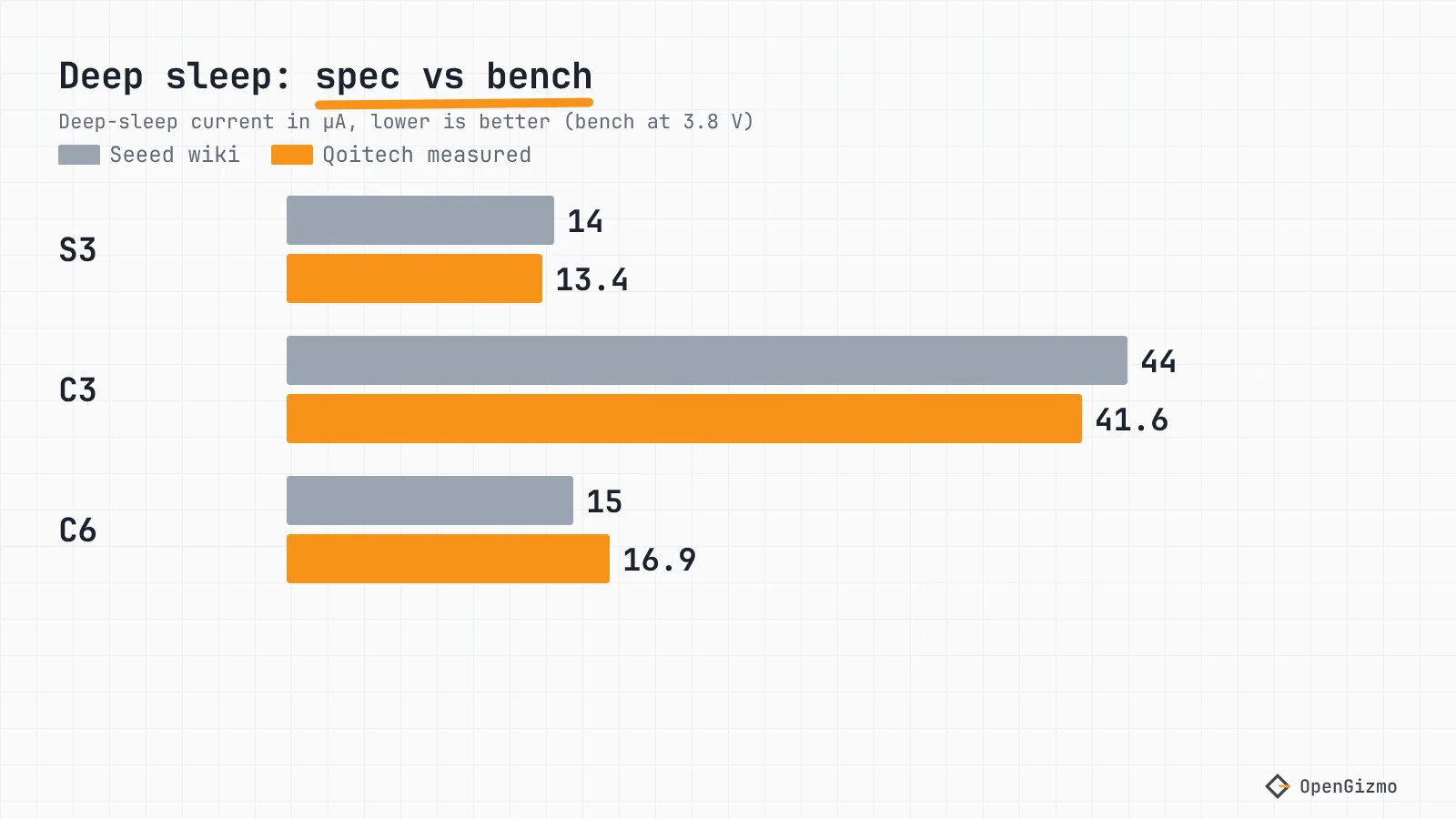
Seeed's numbers are a spec, so how much can you trust them? Qoitech measured the three boards with an Otii Ace Pro on the battery pad at 3.8 V (published August 26, 2026), and its deep-sleep results land within a few microamps of Seeed's: 13.4 µA on the S3, 41.6 µA on the C3 and 16.9 µA on the C6. Their test ran ESP-IDF 5.5.3 with no radio stack and one LED GPIO, which is a bare-bones firmware, not a real gadget. Light-sleep is where the spec and the bench part ways: Seeed lists 2 mA, 4 mA and 3.1 mA for the S3, C3 and C6, while the bench read 692, 193 and 220 µA. Qoitech explains the gap as Seeed measuring with Wi-Fi connected and its own test running with the radio off. The S3's 692 µA also needed CONFIG_ESP_SLEEP_POWER_DOWN_FLASH: Qoitech's first S3 reading was 2.88 mA.
So the honest summary is that deep sleep is a tie between the S3 and the C6, and the C3 board draws roughly three times as much. That is surprising, because the C3 datasheet quotes 5 µA for the chip in Deep-sleep mode, the lowest of the three chips (Qoitech's table lists 7 µA for the S3 and C6), so the extra draw comes from the board. The chip versus dev board breakdown goes through where the board's overhead comes from, and I did not measure any of these boards myself.
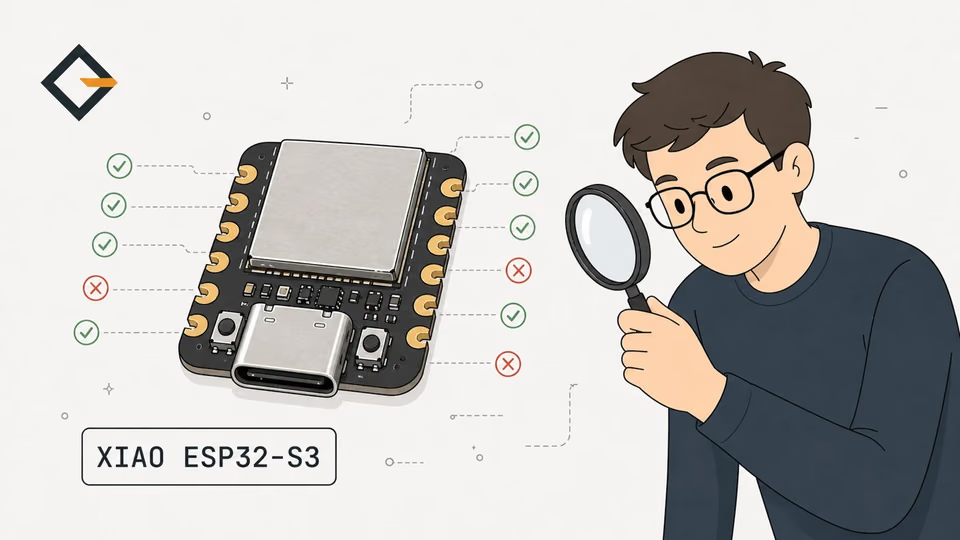
What are the XIAO ESP32-S3 Sense and the S3 Plus?
Both use the same ESP32-S3 chip as the standard board, and Seeed's wiki lists them in the same table:
| Variant | What it adds (Seeed wiki) | Watch out for |
|---|---|---|
| XIAO ESP32-S3 | The baseline: 8 MB PSRAM, 8 MB flash, 11 GPIOs | No camera, no SD slot |
| XIAO ESP32-S3 Sense | OV5640 camera, digital microphone and an SD card slot on an expansion board | 21 x 17.8 x 15 mm with the board; the page says an OV3660 may ship instead of the OV5640 |
| XIAO ESP32-S3 Plus | 16 MB flash, 18 GPIOs, a second UART and SPI, 100 mA fast charging | Deep sleep 33.51 µA against 14 µA; the extra pads are small half-hole lands |
The Plus is the one that surprises people on battery, because Seeed lists more than double the standard board's deep-sleep current for it. The espboards.dev page for the Plus agrees with that number and adds that using the nine extra pads means soldering the board flat onto a carrier, since there is nothing to plug a header into. It also reports 20 GPIOs against the 18 on Seeed's wiki, so I would count the pads on the board you receive. For the pins each variant takes, see the XIAO ESP32-S3 pinout guide.
Which XIAO suits a display, a camera or a battery gadget?
Match the board to the part that needs the most from it:
- LED matrix, LCD or any display with a web interface. The S3, for the headroom: it is the only one of the three with PSRAM. Derek Seaman, who runs all three under ESPHome, also recommends the S3 for heavier processing such as cameras or AI/ML in his 2026 comparison.
- Camera. The XIAO ESP32-S3 Sense, which is the only one of the family with a camera in the wiki. The C3 and C6 have none.
- Thread, Zigbee or a Bluetooth proxy for Home Assistant. The C6. In that same article, Seaman says he standardized on it for Bluetooth proxies, citing Wi-Fi 6, Thread, Zigbee and a toggle for the external antenna. That is his opinion on his setup, not a benchmark.
- A battery gadget that sleeps most of the day. The S3 or the C6, which are tied in deep sleep. The C3's 44 µA board figure is a poor start unless its charger matters: Seeed's wiki lists 380 mA fast charging for it, against 50 mA on the standard S3.
- A cheap, simple Wi-Fi sensor. The C3, with the caveat that I did not compare prices or stock for any of these boards, so check the shop on the day.
One more limit for the C3: Seaman writes that it made a poor Bluetooth proxy until the 2026.1 ESPHome build added optimizations, and he would still choose another model for that job. If your firmware is heavier than a sensor loop, that is the kind of headroom problem to expect.
Why do OpenGizmo's Ticker and Reolink Switch use the XIAO ESP32-S3?
Both projects use it, and the repositories say so: the platformio.ini of the Gizmo Ticker and of the Gizmo Reolink Switch both name it as the release board in a comment. I did not find a written reason for the choice, so I will only state what the code and files show. (The Gizmo Camera is the exception: it runs on an AI Thinker ESP32-CAM.)
The firmware is wired to the S3 on purpose. The Ticker's config.h defines the MAX7219 pins only when ARDUINO_XIAO_ESP32S3 is set and stops the build with an #error otherwise. The release workflow builds for ESP32-S3 only, and the website's flasher picks the build that matches the connected chip, so a C3 or a C6 would find no build to flash. The ESP Web Tools post explains that flow. USB is not the reason: both the C3 and the C6 have USB Serial/JTAG, according to their datasheets, so browser flashing would work on them in principle.
What the S3 gives these projects is room. Both platformio.ini files use huge_app.csv, one 3 MB app slot with no wireless updates, and the Ticker runs an async web server plus HTTPS calls to CoinGecko through WiFiClientSecure. I did not measure heap use, and I never built the firmware for a C3 or a C6, so I cannot say it would not fit. What I can say is that the shared enclosure was designed around the S3: the part notes I keep for the enclosures record its USB-C, U.FL and antenna positions, confirmed on that board only. A C3 or C6 has the same 21 x 17.8 mm outline per Seeed, but the C6's ceramic antenna would change the antenna rules, and I did not test either. The enclosure design guide covers how a board is held.
The pads also decide. The Ticker's SPI pads and the Reolink Switch's I2C, button and buzzer pads are chosen against the S3's pinout, including its D2 (GPIO3) strapping pin. Seeed labels the pads D0 to D10 on all three XIAOs, but I did not compare which GPIO sits behind each label, and the strapping pins differ by chip, as the strapping pins by chip guide shows, so a rewire is part of any port.
What should you remember when choosing a XIAO?
The short version is: S3 for most projects, C6 for Thread, Zigbee and Wi-Fi 6, C3 for a simple node where its 44 µA deep sleep does not matter. All the numbers come from Seeed's wiki pages and Qoitech's August 2026 bench report, as of November 2026.
The limits are plain. Seeed's wiki has inconsistencies (the S3 charging cells are merged, the C6 Bluetooth version differs between sections, and the C3 deep sleep is 44 µA in one place and about 43 µA in another), I did not measure any board, and I did not check prices, stock or board revisions. For the chip-level view, read what the ESP32 is and which ESP32 to buy, and for the pins of the board OpenGizmo uses, the XIAO ESP32-S3 pinout.
Frequently asked questions
Find quick answers to the most common questions about this topic.
For most projects, yes. Seeed's wiki lists the XIAO ESP32-S3 with two Xtensa cores at up to 240 MHz, 8 MB of PSRAM and 8 MB of flash. The XIAO ESP32-C3 has one 160 MHz RISC-V core, 400 KB of SRAM and 4 MB of flash, so it suits simpler Wi-Fi nodes.

Author
Mauro BrambillaReady to build your own gizmo?
Pick an open-source ESP32 project and follow its step-by-step guide, from the parts list and wiring to the firmware and the first boot.