CoinGecko API on ESP32: Free Limits and Polling Rate
CoinGecko's free Demo plan allows 100 calls a minute and 10,000 a month. The polling math for an ESP32, how to send the key, and what HTTP 429 means.
- Author
 Mauro Brambilla
- Published
- Reading time
- 7 min
- Category
- Guides
In short
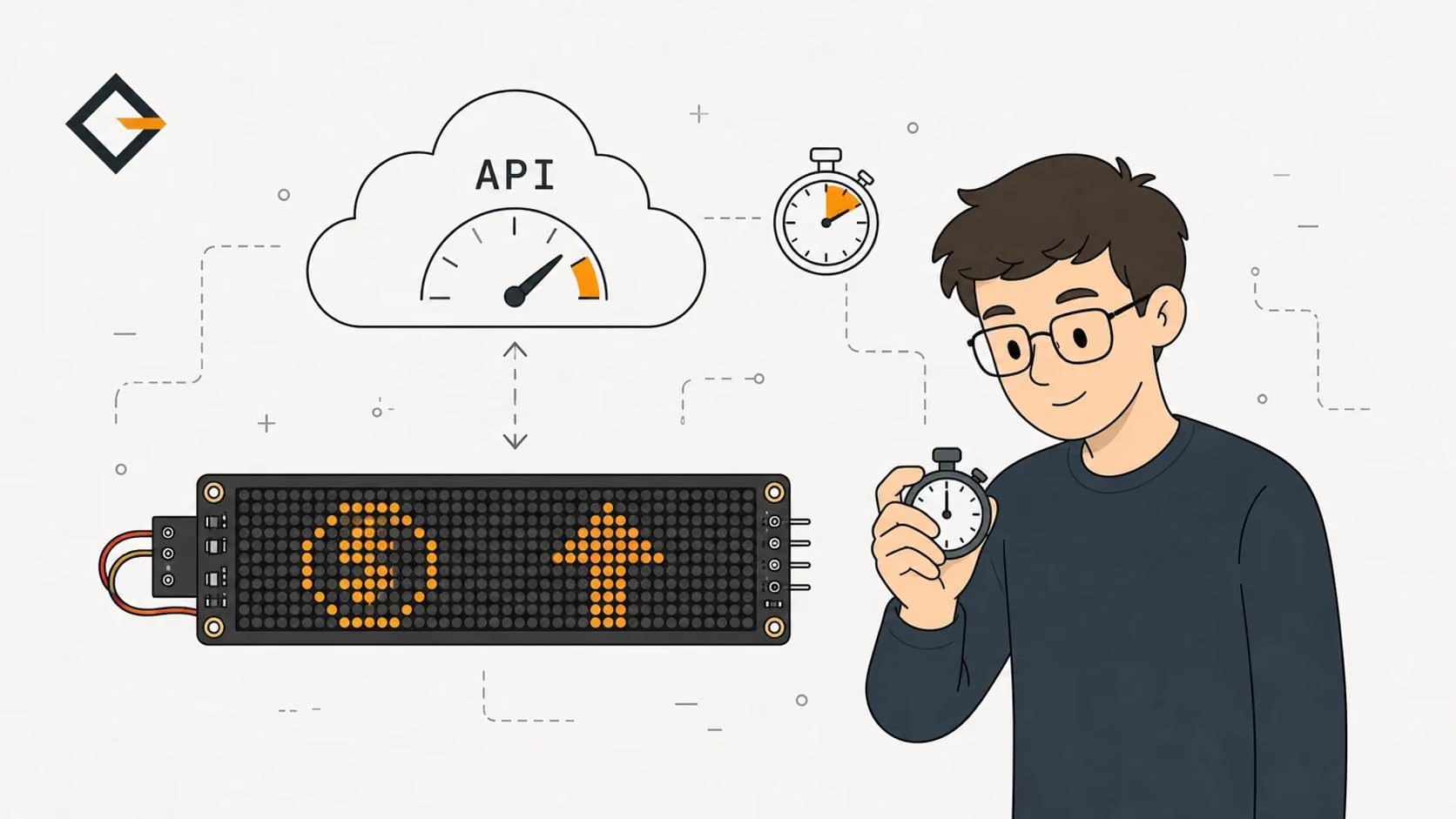
As of November 2026, CoinGecko's free Demo plan gives 100 calls per minute and 10,000 per month. An ESP32 polling every 6 minutes uses about 7,200 calls in 30 days, so one device fits.
The CoinGecko API is free for hobby projects: its Demo plan costs $0, needs no credit card and, as of November 2026, allows 100 calls per minute and 10,000 calls per month. An ESP32 that polls once every 6 minutes makes about 7,200 calls in 30 days, so one board fits under the cap.
Maybe you are about to flash a ticker and wonder how often it may ask for a price before CoinGecko cuts it off. In this guide we will work out the polling math, read the real Gizmo Ticker firmware to see how it sends its key and schedules calls, and look at what a 429 does. The numbers come from CoinGecko's own pricing and docs pages, and the timings from the firmware source.
What are the CoinGecko Demo plan limits?
The Demo plan is CoinGecko's free tier: a key you request from CoinGecko, with a per-minute rate limit and a monthly call budget. As of November 2026, the pricing page and the errors and rate limits page say this:
| Item | Demo plan (free) | Keyless public API |
|---|---|---|
| Price | $0 per month, no credit card | Free |
| Rate limit | 100 calls per minute | About 5 calls per minute, IP-based and shared |
| Monthly budget | 10,000 calls (10k call credits) | Not stated |
| Cost of one call | 1 call = 1 credit | Not applicable |
| Attribution | Required | Required |
| Commercial license | Not listed on the pricing page | Not included; CoinGecko points to a paid plan |
| Production use | Meant for personal projects | Not recommended |
The keyless column comes from CoinGecko's keyless public API page. It says the pool is shared by everyone on the same IP, that the real limit varies with server load, and that it is not recommended for production environments. A ticker that runs unattended all day is closer to production than to a quick test, so use a Demo key.
Older posts often quote 30 calls per minute for the free tier. I could not check that against an archived CoinGecko page, so this post only uses the figures on its pages today. Re-check them before you design around a limit.
One thing I could not confirm: the pricing page does not say what happens on the Demo plan when the 10,000 calls run out. Its overage text covers paid plans only. Plan to stay under the cap rather than test it.
How many calls per month does an ESP32 use?
A month has 43,200 minutes in 30 days. Each poll is one call, so:
calls per month = 43,200 ÷ interval in minutes
That gives you the budget for any interval. The cap is 10,000, so the shortest safe interval for one device is 43,200 ÷ 10,000 = 4.32 minutes. A 31-day month raises the total by about 3% (44,640 minutes), which moves the limit to about 4.5 minutes. In practice, 5 minutes is the floor if you want a margin.
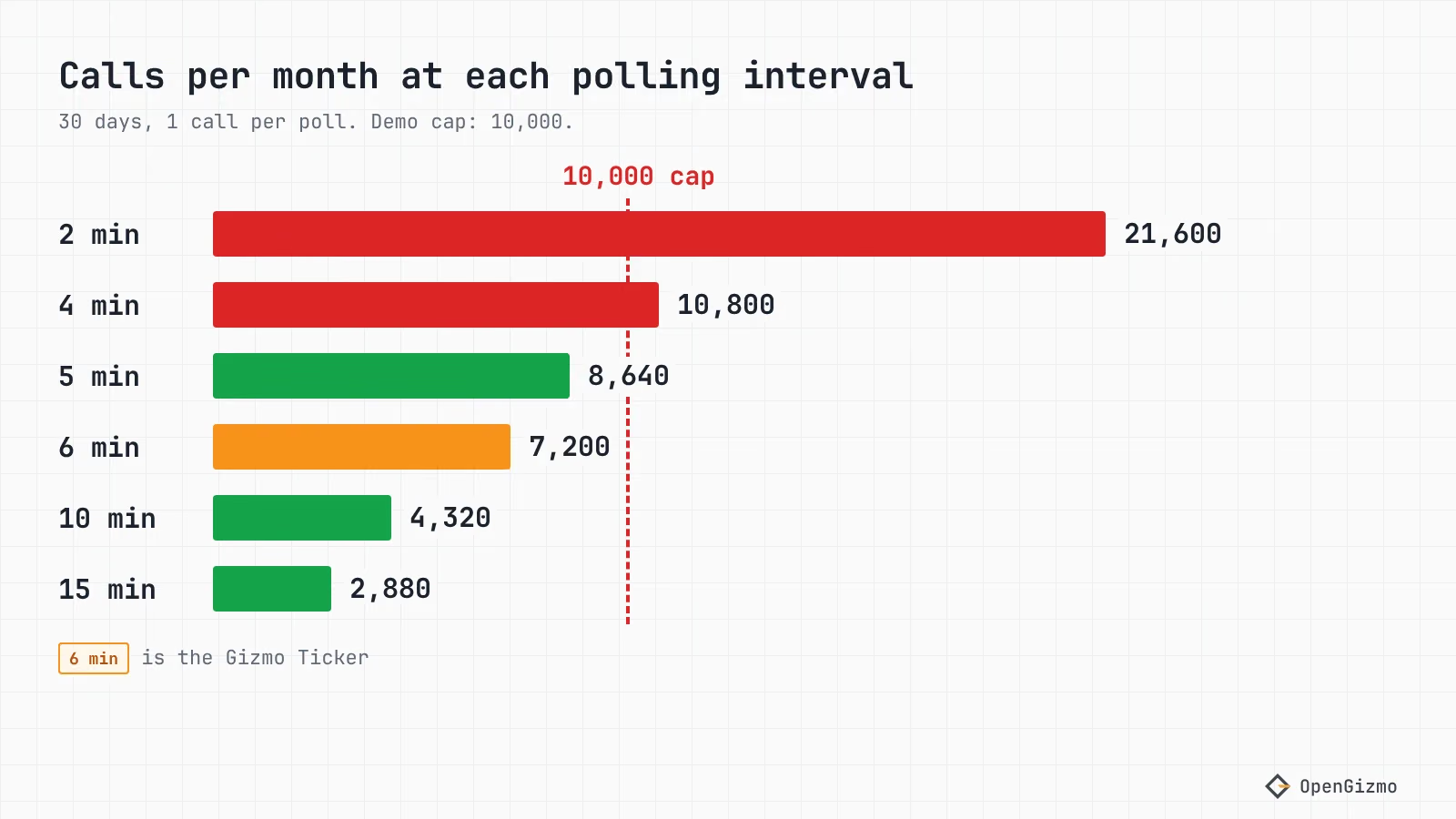
| Polling interval (min) | Calls per hour | Calls per 30 days | Under the 10,000 cap? |
|---|---|---|---|
| 1 | 60 | 43,200 | No |
| 2 | 30 | 21,600 | No |
| 4 | 15 | 10,800 | No |
| 5 | 12 | 8,640 | Yes |
| 6 (Gizmo Ticker) | 10 | 7,200 | Yes |
| 10 | 6 | 4,320 | Yes |
| 15 | 4 | 2,880 | Yes |
Notice that the per-minute limit never matters here. At one call every 6 minutes you use about 0.2% of the 100 calls per minute. The monthly budget is what limits a device, and it limits it hard.
How does the Gizmo Ticker poll CoinGecko?
The ticker polls once every 6 minutes. In market_refresh.h the constant MARKET_REFRESH_INTERVAL_MS is 360000, and a failed call is retried after MARKET_RETRY_INTERVAL_MS, which is 30000 (30 seconds). The scheduling logic is in market_refresh.cpp.
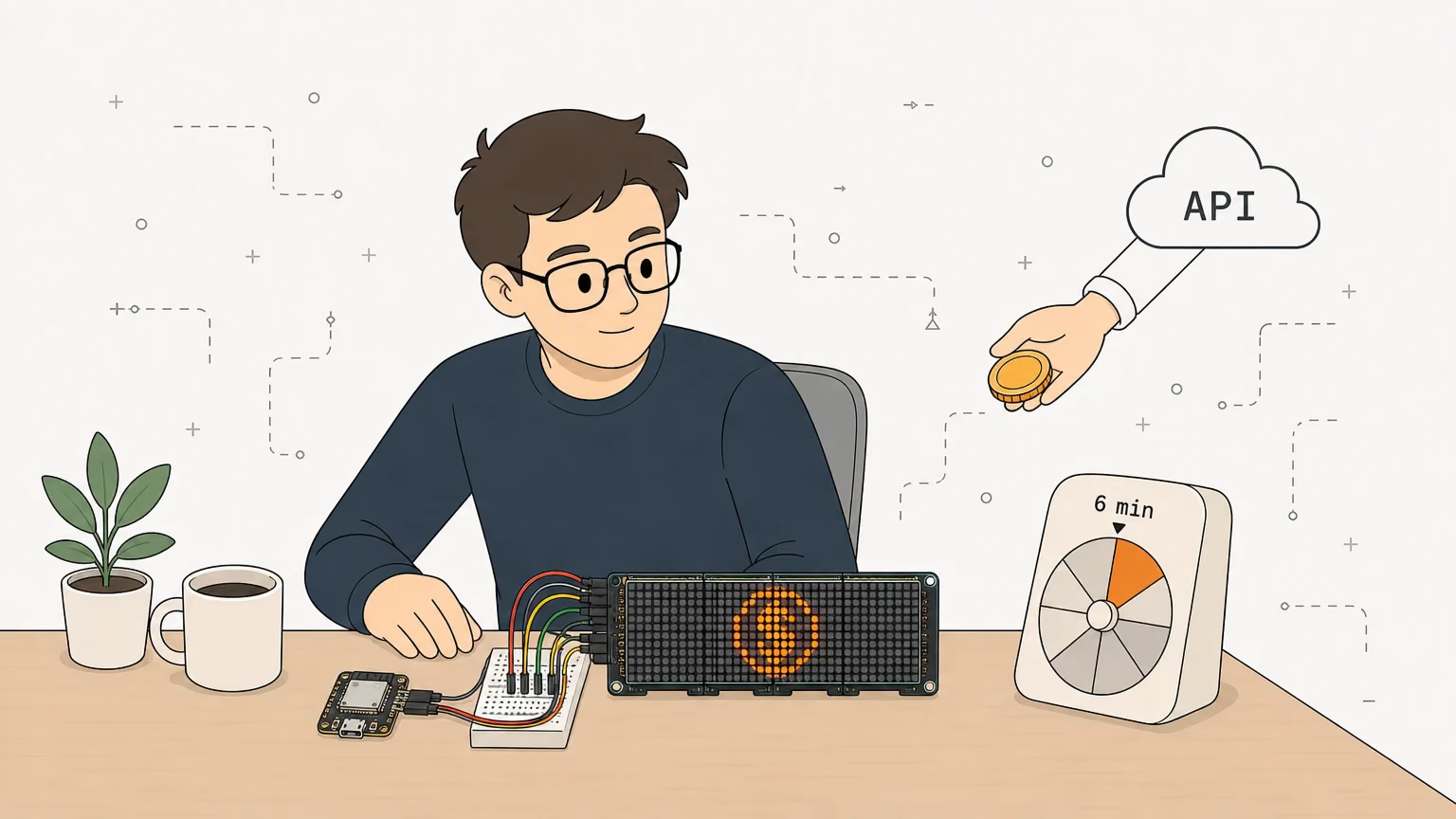
Why 6 minutes? The repository does not record the reason, so I won't invent one. What the math shows is that 6 minutes leaves about 2,800 calls of headroom out of 10,000 in a 30-day month (about 2,560 in a 31-day month). That spare room is used by everything that is not a scheduled poll:
- A fetch right after boot, because the schedule starts with a request already pending.
- A fetch after you save a new API key or change the coin in the web app.
- The 30-second retries while a call keeps failing.
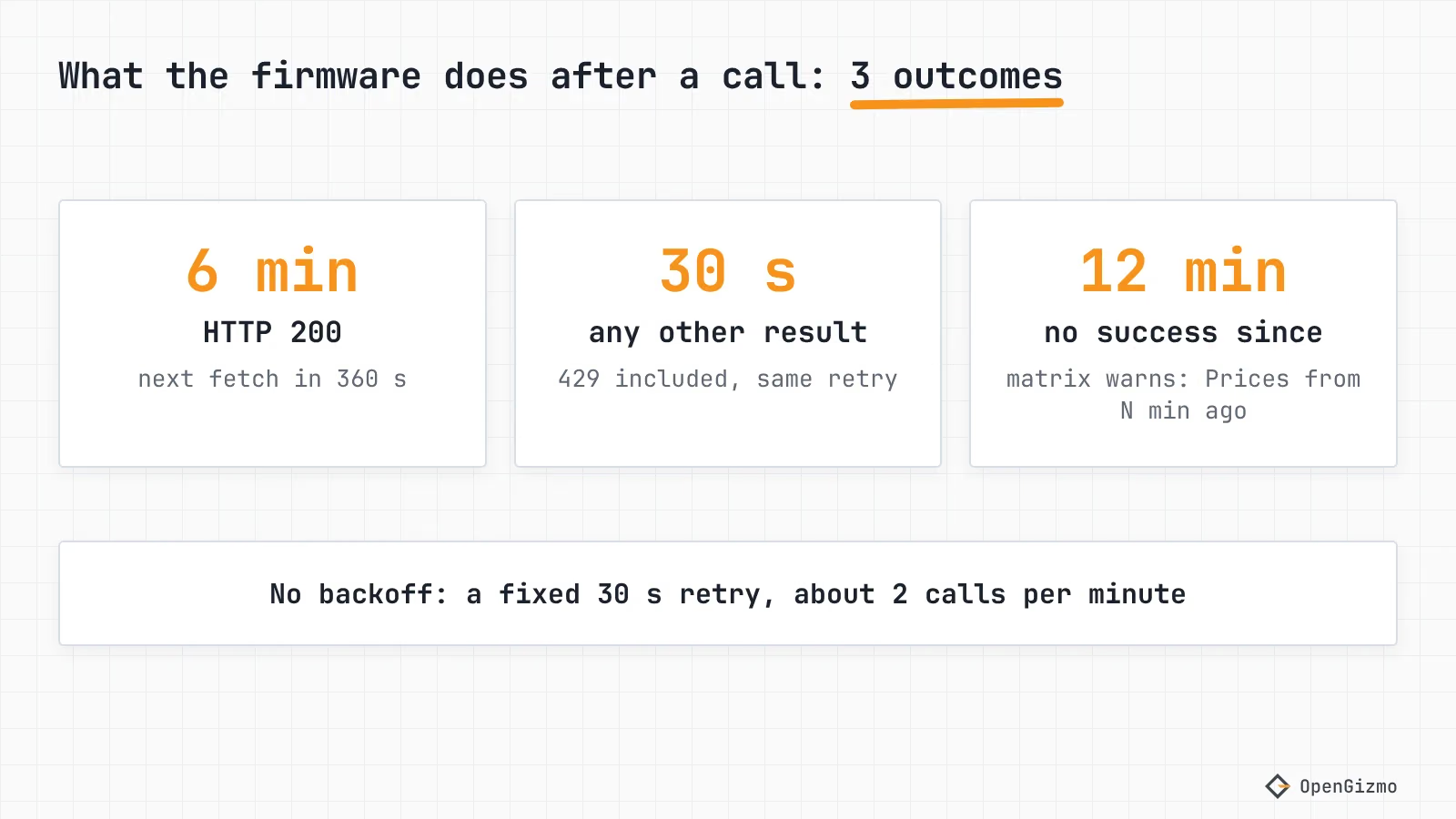
When the data gets old, the firmware tells you. If 12 minutes (MARKET_STALE_AFTER_MS, twice the refresh interval) pass without a success, the matrix opens each cycle with Prices from N min ago. and the last error. For the full build, see how to build a crypto ticker with ESP32 and MAX7219.
How do you send the Demo API key from an ESP32?
CoinGecko's Demo authentication docs give two options: the header x-cg-demo-api-key (recommended) or the query parameter x_cg_demo_api_key. The base URL for a Demo key is https://api.coingecko.com/api/v3/. The firmware in api.cpp uses the header:
const char marketApiUrlTemplate[] = "https://api.coingecko.com/api/v3/coins/markets?vs_currency=usd&ids=%s&price_change_percentage=24h";
const char apiKeyHeaderName[] = "x-cg-demo-api-key";
...
http.setTimeout(5000);
http.addHeader("Accept", "application/json");
http.addHeader(apiKeyHeaderName, getDeviceConfig().apiKey);
const int httpCode = http.GET();
if (httpCode != HTTP_CODE_OK) {
    http.end();
    return false;
}A header also keeps the key out of the request URL, which the firmware prints to its serial log (Requesting URL: ...). That is my reasoning for the header, not a CoinGecko statement. Each poll is one /coins/markets request for one coin, which is why one poll costs one call. The firmware also asks for only the fields it displays through an ArduinoJson filter, to save memory.
The key itself never lives in the code. You paste it into the API Key page of the board's web app, and it is saved on the board in a buffer of 35 bytes, so at most 34 characters. Without a key, the firmware does not call CoinGecko at all and scrolls API key is not present. instead. To enter it you first need the board on your Wi-Fi: the Wi-Fi provisioning comparison explains how the setup hotspot works.
Before celebrating, test the key from a computer:
curl -s -o /dev/null -w "%{http_code}\n" -H "x-cg-demo-api-key: YOUR_KEY" "https://api.coingecko.com/api/v3/coins/markets?vs_currency=usd&ids=bitcoin"A 200 means the key works. Per CoinGecko's error list, a 401 means a missing or invalid key, and error code 10011 means you sent a Demo key to the wrong host.
What happens when the ESP32 gets HTTP 429?
HTTP 429 is "Too Many Requests": you went over the rate limit. CoinGecko counts every request toward the limit, including those that return 4xx and 5xx errors, so errors do not give a failing device a free pass. Its docs suggest reducing the call frequency or upgrading the plan.
What does the ticker do? Anything that is not a 200 is treated the same way: fetchMarketData returns false, the schedule picks the 30-second retry, and the matrix keeps showing the last good data. There is no special case for 429 and no backoff, and the firmware does not read any rate-limit header. I did not find Retry-After or rate-limit headers described on CoinGecko's error page either, so I can't tell you what the server sends.
Is that a problem? With one device, hardly. A permanent retry every 30 seconds is 2 calls per minute, far under 100. The risk is different: during a long outage on either side, those retries add up. One hour of failures is about 120 calls, over 1% of the monthly budget. If you modify the firmware, an exponential backoff, which CoinGecko itself advises for the keyless API, is the sensible change. Whether a failed call also uses a monthly credit is documented for the Pro plan (it does not, per the Pro authentication page) but not for Demo, so I would not count on it.
If you see 429 on a real ticker, change one thing at a time:
- Check how many devices use the key. The quota belongs to the key, so two boards polling every 6 minutes make about 14,400 calls in 30 days.
- Check that nothing else uses the key, such as a script or a second project.
- Lengthen the polling interval. At 10 minutes, one key can feed 2 boards (8,640 calls).
If you do not own the key, ask the owner first.
What are the alternatives when the free plan is not enough?
Within CoinGecko, there are two paths. The keyless API needs no sign-up but is shared and limited to about 5 calls per minute, which CoinGecko does not recommend for production. A paid plan raises the limits and adds commercial licensing, and the pricing page lists the plans. I did not compare other price providers, so I can't make claims about their free tiers.
A cheaper trick is to poll less. Crypto prices move all day, but a decorative display does not need minute-by-minute accuracy. Going from 6 to 10 minutes cuts the monthly calls from 7,200 to 4,320 and leaves room for a second device or for retries.
One more thing: Demo data requires attribution. If you publish a project that shows CoinGecko prices, follow CoinGecko's attribution guide, which the pricing page links from its Demo row.
What did we verify, and what is still open?
We checked the Demo plan against CoinGecko's pages as of November 2026: 100 calls per minute, 10,000 calls per month, 1 call = 1 credit. We worked out that a poll every 6 minutes costs about 7,200 calls in 30 days, read the firmware to confirm the header, the endpoint and the 6-minute and 30-second timings, and saw that a 429 gets the same fixed retry as any other failure.
I did not test what happens at 10,000 calls, and CoinGecko's numbers have changed before, so check the pricing page if a ticker starts failing after months of working. The firmware also uses an HTTPS client without certificate verification, as noted in the build guide.
Next, if you are still wiring the display, read the MAX7219 FC16 wiring guide. For the full picture of the project family, see what OpenGizmo is.
Frequently asked questions
Find quick answers to the most common questions about this topic.
Yes. CoinGecko's Demo plan costs $0 per month with no credit card, and, as of November 2026, allows 100 calls per minute and 10,000 calls per month. CoinGecko requires attribution, and its pricing table lists a commercial license only on paid plans, so a personal hobby ticker is the intended fit.

Author
Mauro BrambillaReady to build your own gizmo?
Pick an open-source ESP32 project and follow its step-by-step guide, from the parts list and wiring to the firmware and the first boot.